
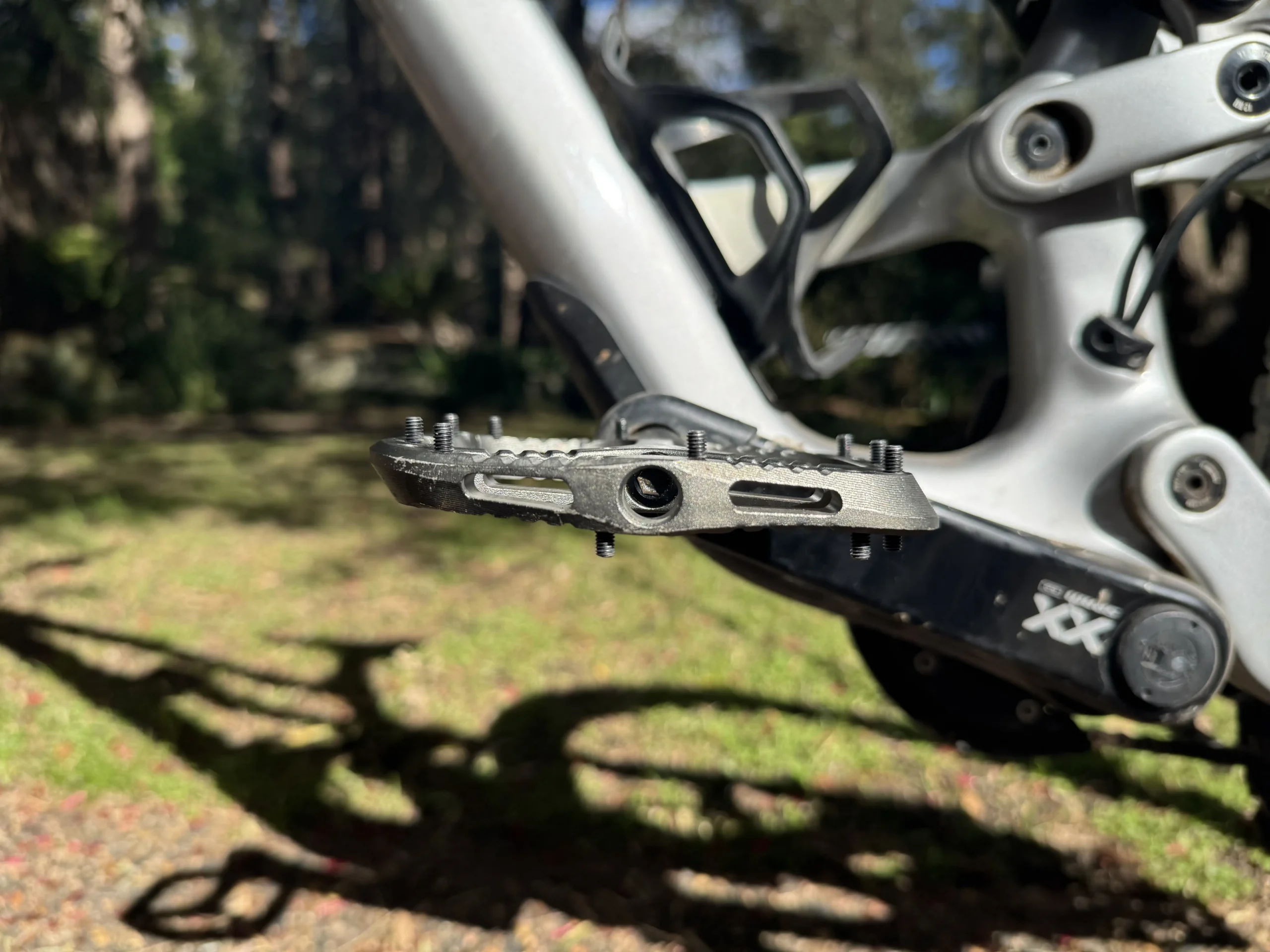
I didn't plan on buying new pedals in the middle of a Whistler trip. I'd spent the first few days trying to convince my mates that composite flats were the way to go, after six months of fairly hard riding on Crankbrothers Stamp 1s. Then one snapped on the Dirt Merchant road gap.
With three days of the trip gone and seven left, I walked into Fanatyk in Whistler Village. After they laughed at me for riding composites on 50ft jumps, I came out with a set of OneUp Wave pedals.
I paid for these myself. OneUp hasn't seen this review and has had no input.
The Wave design
Most flat pedals are either concave (dished) or convex (domed). The Wave combines the two: the front half is dished to cup the ball of your foot, while the back slopes down to encourage a dropped heel. The pins are angled forward too, by up to 10 degrees, so they stand vertical once your heel drops.
OneUp Wave pedal specs
Weight: 355g (pair, claimed)
Platform: 107mm wide x 110mm long
Thickness: 14.2mm at the axle, 11.5mm at the edges
Body: Forged and CNC'd 6061 aluminium
Internals: Inboard igus bushing, 3 outboard cartridge bearings, chromoly axle
Pins: M4 hollow hex, 10 positions per side (9 fitted from the factory), 10 spares in the box
Also in the box: Pedal Bearing Nut Tool
Warranty: 2 years
AU price: around AUD 259.95 RRP
Those are the claimed specifications and Australian RRP. For current offers, check the Boosted MTB deals page.
Grip: 8/10
Plenty of grip where it counts
Right from the first run, the Waves gave me a confident feeling of being connected to the bike when things got rowdy. I haven't once felt like my foot could slip off the front on a heavy hit. That security has worked well for the downhill, enduro and jump riding I do.
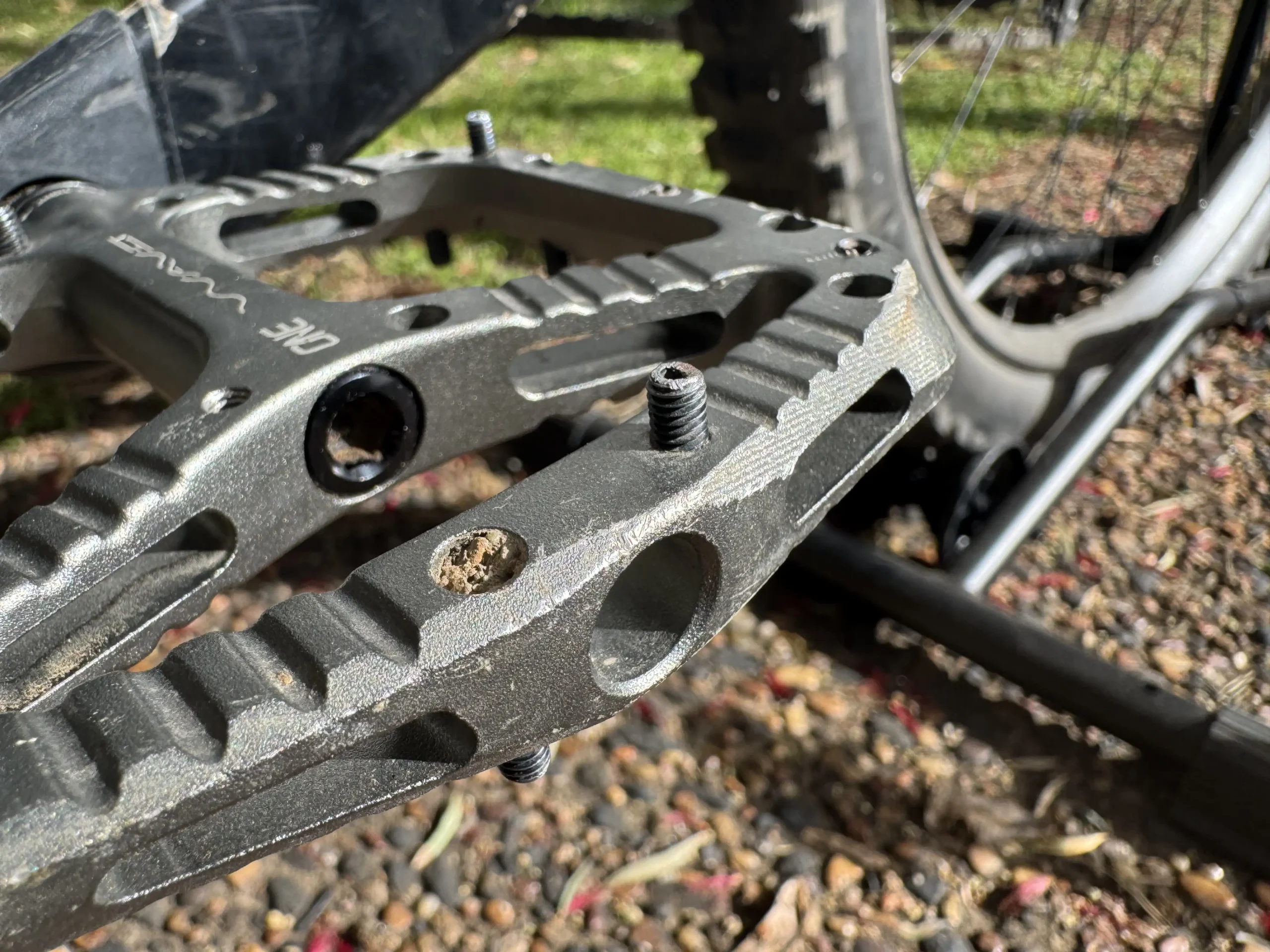
Foot position and heel drop
It doesn't force anything, but dropping my heels is easier than on any pedal I've used
I've never quite settled on a pedal shape. My flexibility through my ITBs, legs and ankles is poor, and dropping my heels doesn't come naturally. Concave pedals can lock my foot in a position that doesn't feel right, while convex pedals have left me with foot cramps and a feeling of never being properly secure.
I don't actively think about where my feet go. If it feels good, that's where they stay. On the Waves, dropping my heels into a balanced, supported stance takes less effort. The sloped back half meets my foot at the angle I'm trying to reach, rather than me fighting a flat or domed platform. I've often wondered whether my difficulty dropping my heels comes down to anatomy. That could still be part of it, but these pedals have helped.
They also feel softer and more natural underfoot than any alloy pedal I've ridden, including OneUp's original Aluminium pedals. It's the closest I've come to the soft composite feel I liked, with an alloy body. I suspect that's down to how the Wave shape interacts with the support in my shoes. Your shoes, foot size and usual stance will all affect how it feels.
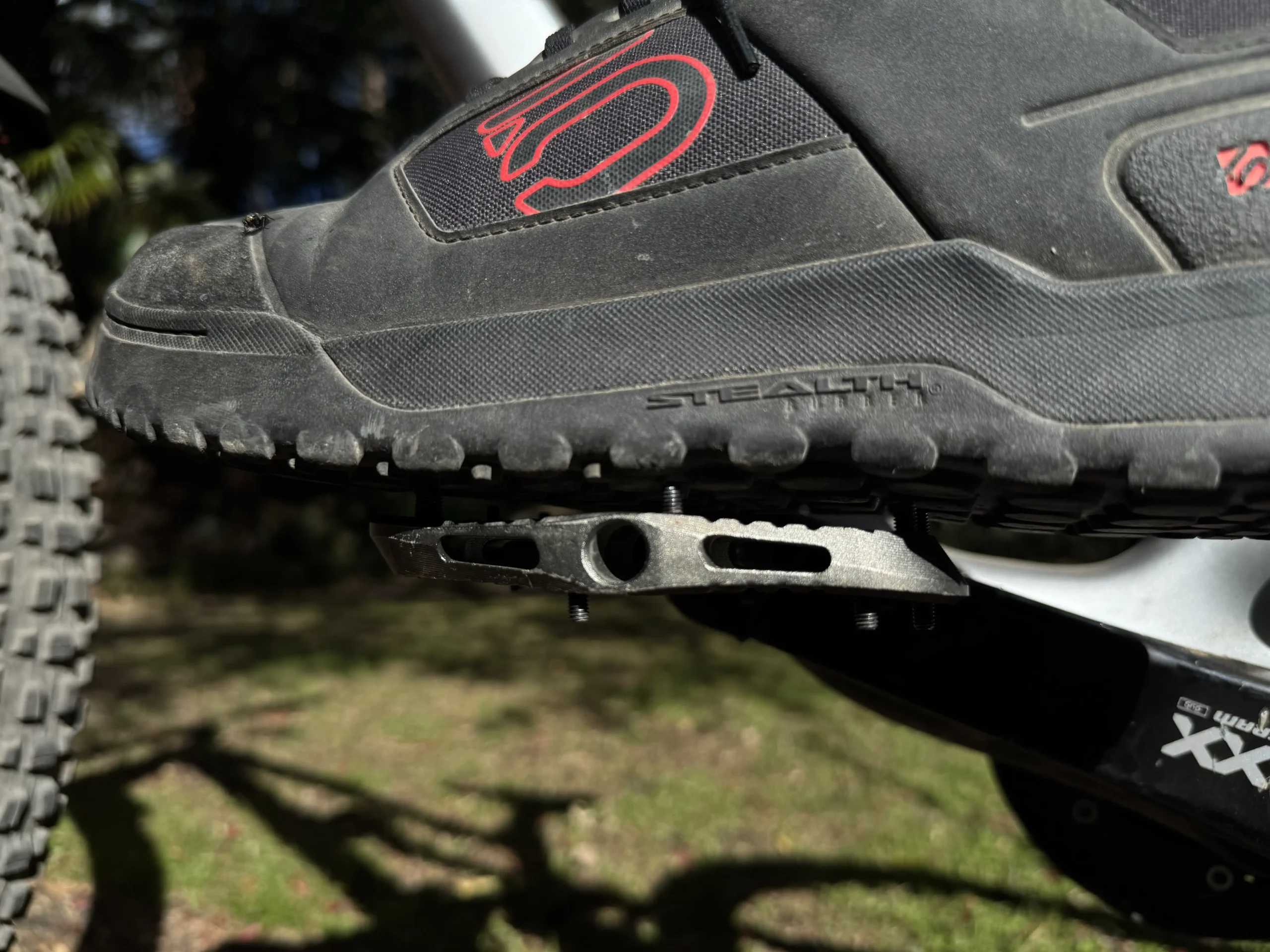
Moving your feet: 7/10
Easy to adjust on the fly, but tricks need a cleaner lift
My concern with that much grip was whether I'd feel stuck in one position. In practice, if my foot lands slightly out of place, I can shuffle it into the sweet spot mid-run. The back of my foot can move without losing that secure feeling front-to-back.
Taking a foot off for a nac-nac needed an adjustment, though. Early on, the front of my shoe would catch as I swung it away. Lifting clear of the pedal before moving sideways solved it; trying to slide straight off was the problem.
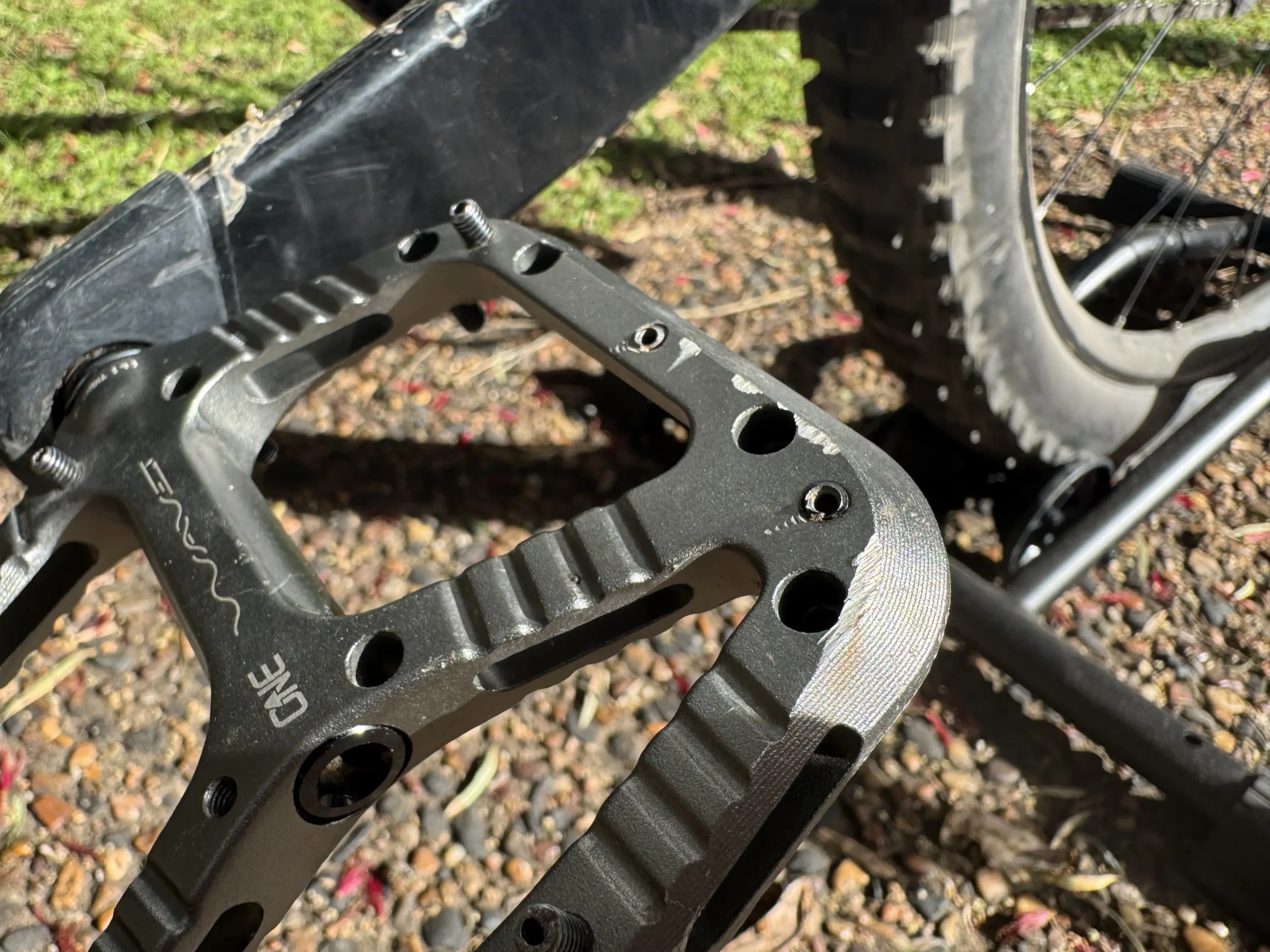
I've left the tenth pin hole empty on each face. The nine fitted pins give me enough grip, and adding another would only make it harder to get my foot clear for tricks. The spares are there if you want to try more grip.
Durability: 8/10
After seven days in Whistler bike park, a couple of months on local trails and a handful of shuttle days around Sydney and NSW, the Waves still spin smoothly with no play. A few rock strikes sounded like they'd done serious damage, but left scratches rather than obvious gouges or damage to the body.
I've snapped three pins so far. They're designed to break off cleanly to protect the threads in the pedal body, and mine were quick and easy to replace. It's too early for a long-term durability verdict, but the body and bearings have held up well so far.
Compatibility and servicing: 9/10
No compatibility issues on my SRAM XX carbon DUB cranks
My Waves are on my XL YT Capra with SRAM XX carbon DUB cranks. OneUp confirms the Wave is carbon-crank compatible and works with crank boots too.
The warning you may remember concerns earlier versions of the original OneUp Aluminium pedal, whose body or seal could contact the crank before the axle was fully tightened. OneUp later revised that model: its guidance says date codes before 5221 may not be compatible, while those after 5221 have the update for SRAM carbon cranks and recessed pedal inserts. Check that if you're buying older Aluminium pedals.
Servicing is another strong point. The bearing nut tool comes in the box, the Wave shares its rebuild kit with OneUp's Clip pedals, and you get 10 spare pins.
Value: 7/10
Not cheap next to composites, but the durability and serviceability help justify the price
At around AUD 260, these cost a lot more than a set of composites. I paid a premium at the Whistler Village shop to get back on the trail that day. I can't call them a bargain.
Replacing a broken pedal mid-trip made durability and serviceability matter more to me. Add the spare pins and a shape that suits my feet, and I think the price is fair, rather than great. If you're already happy with cheaper composites, the Wave is a harder sell.
Verdict: 8/10
A very good flat pedal with a shape that works for me
After riding them, I don't think the Wave shape is a gimmick. It hasn't transformed my riding, but the easier heel drop and natural feel have made a difference. The grip gives me confidence, and I can still adjust my feet when I need to.
If you've been switching between pedal shapes looking for that balance, the Wave is worth a look. If you already drop your heels naturally and love the feel of your current flats, there's less reason to change.
My recommendation is for recreational downhill, enduro and jump riding. Racing at the limit is a different question: if you want the retention of being clipped in, the Wave isn't a substitute for clipless pedals.
OneUp Wave pedals FAQ
Are OneUp Wave pedals compatible with SRAM carbon cranks?
Yes. Mine work with SRAM XX carbon DUB cranks, and OneUp confirms the Wave is carbon-crank compatible. See the compatibility section for the distinction from older OneUp Aluminium pedals.
Does the Wave shape suit every foot position?
Not necessarily. The concave front is designed to support the ball of your foot, but that isn't a rule about where everyone should put their feet. Your usual stance and the way your shoes sit on the platform will affect whether the shape feels natural.
Can you run shorter pins on the Wave?
The pins aren't height-adjustable. OneUp says the only way to run shorter pins is to fit pins from its original Aluminium pedal with the washers from its pin/washer kit.
How often do OneUp Wave pedals need servicing?
OneUp recommends at least once a season, twice a season if you ride every day, or whenever they stop spinning smoothly.
Sources
OneUp Wave Pedals product page and FAQ
Singletracks: The OneUp Wave Pedals force proper foot placement
Vital MTB forum: Some thoughts on the OneUp Wave pedals
OneUp Aluminium Pedals: date codes and SRAM carbon crank compatibility
MTB Direct: OneUp Wave Pedals (AU pricing)
Written and photographed by Tom Ford for Boosted Media
Back to Boosted MTB