
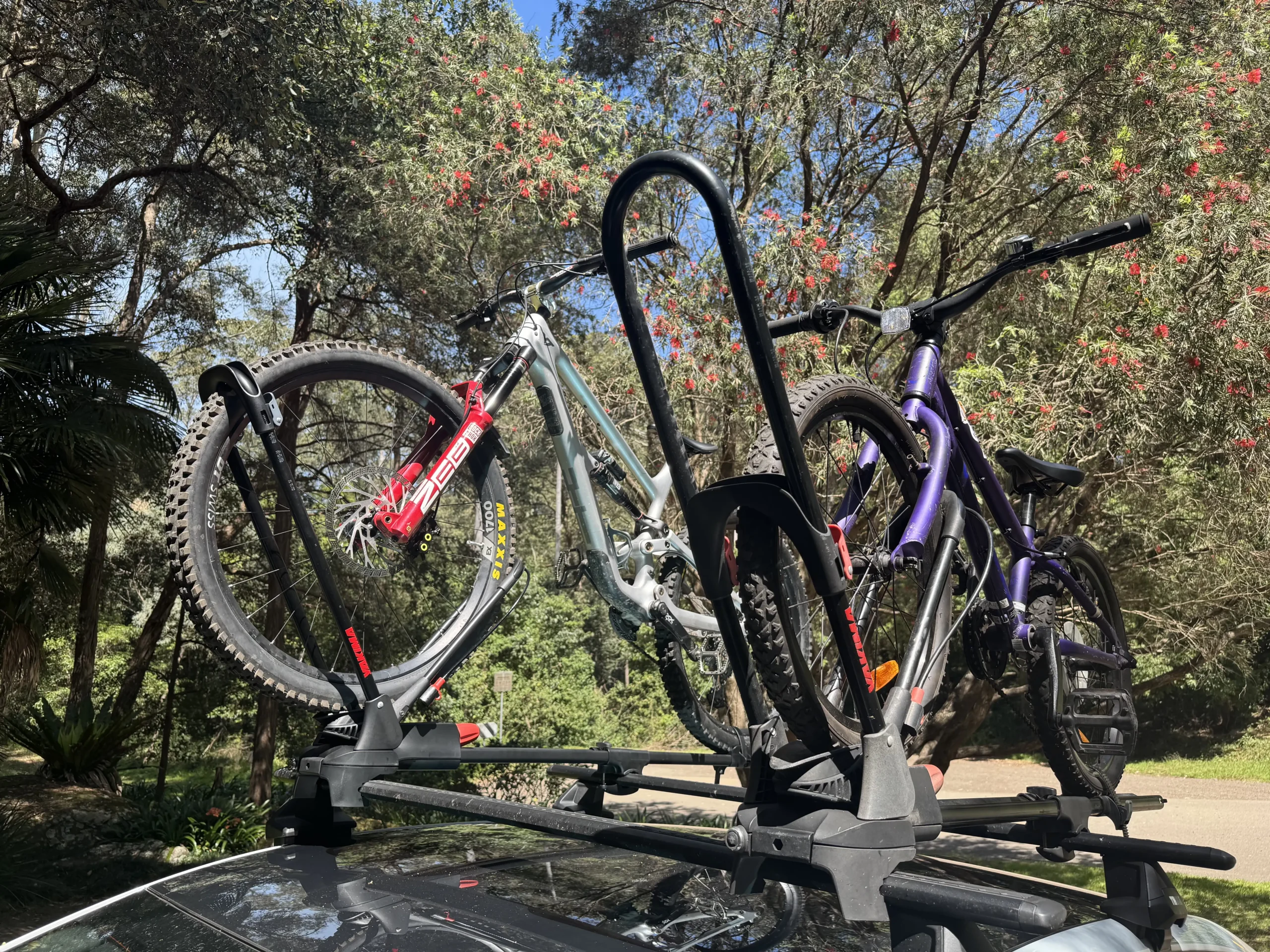
Yakima's FrontLoader is a wheel-on roof rack. The front wheel drops into a two-piece hoop, a red dial clamps it tight, and a ratchet strap holds the back wheel in a sliding tray. Nothing touches the frame, so it doesn't care whether a bike is carbon or alloy, what brakes it runs, what axle standard the fork uses, or how odd the suspension layout is. That's the whole appeal.
My first FrontLoader has lived on sedans, SUVs and station wagons over the last five years, on a mix of aftermarket bars. It now sits on Thule WingBars on my Polestar 4. The second one came home from 99 Bikes on sale for $230, because my kids now need their own spot on the roof. It went straight out of the box and onto the car for a 24-inch kids' bike on its first trip.
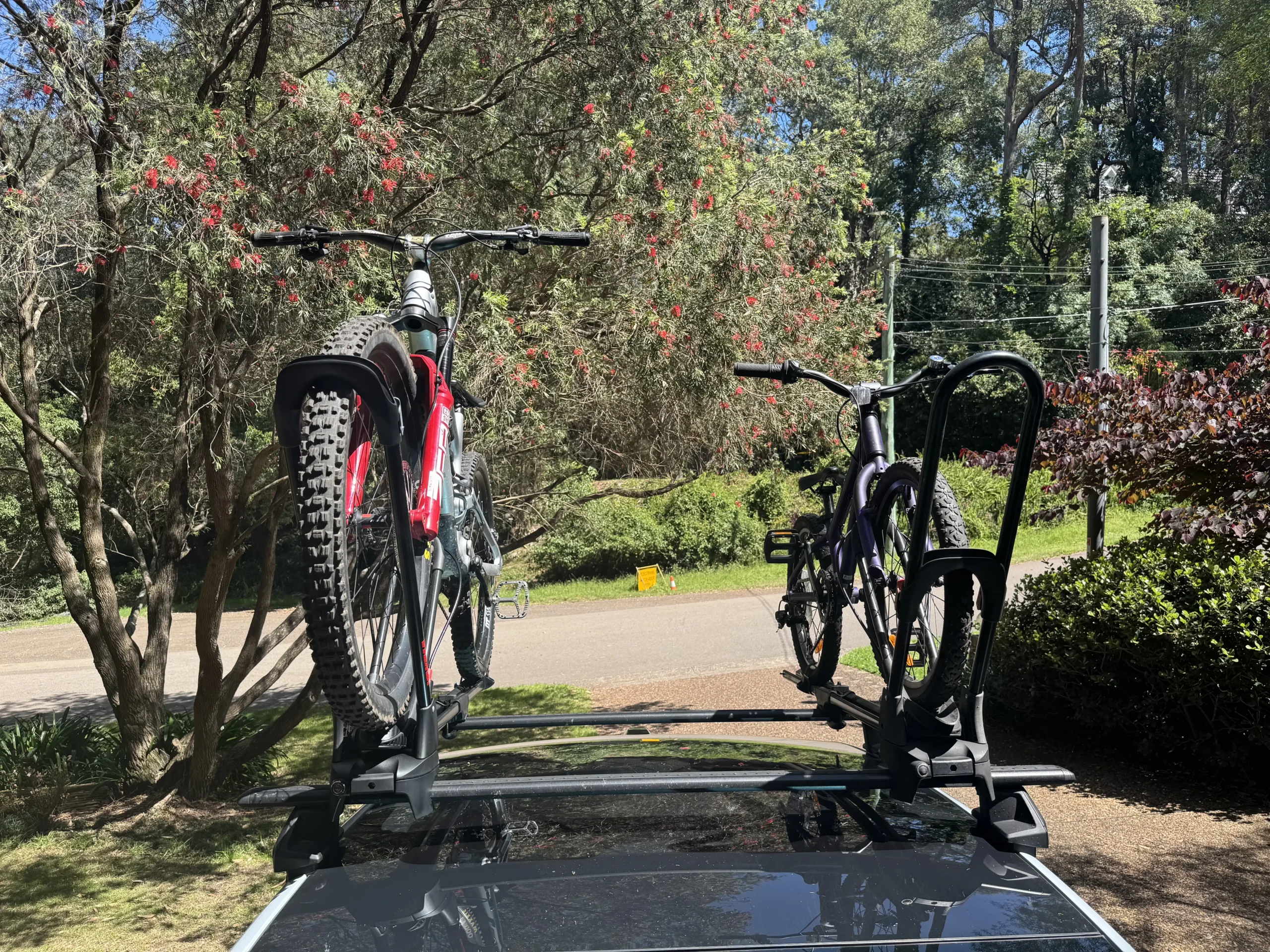
Both FrontLoaders side by side on the Polestar 4
A quick disclosure before I get into it: I bought both racks with my own money. At the time of writing I have no affiliate or brand relationship with Yakima, 99 Bikes or anyone else in the bike industry, and nobody has any input into my opinions.
Who is the FrontLoader for?
Families and riders with a mix of bikes. It takes everything from 20-inch kids' bikes up to trail and enduro bikes, and you never have to think about frame material, brakes or axles.
Like any roof rack it has a weight and wheelbase limit, so check the specs below against your bike. If you own a Large or bigger 29er, read the end cap section below before you buy.
Yakima FrontLoader specs
Pricing changes often, so check boostedmtb.com for live pricing and current deals. Specs from Yakima AU and US retailer listings.
Value: 10/10
At $230 it's a bargain, and it's still fair at full price
I paid $230 for my second FrontLoader at 99 Bikes, against $369 direct from Yakima AU. At that price I didn't bother shopping around, and after five years with the first one I didn't feel I needed to.
The obvious step up is Yakima's own HighRoad, which takes heavier bikes, longer wheelbases and wider tyres. But it costs a lot more than I paid, and for a family's worth of bikes the FrontLoader does the job very well.
The only extra money I've spent in five years was about $30 on a replacement rear wheel tray (more on that below).
Ease of Use: 9/10
Front wheel in, twist the dial, ratchet the back wheel, done
The new rack was ready straight out of the box. Pop it onto the bars, tighten the mounts, and it's on. There's a big range of adjustment for where the rear crossbar clamp sits along the base, and it simply slides along. I've moved my first rack between quite a few cars with different bar spacing and never had trouble lining it up.
Loading is where the FrontLoader shines. Once the front wheel is in the hoop, the bike stands up on its own. That gives you a free hand to sort out the back wheel, which matters a lot when you're holding a bike above your head.
My technique on taller cars: push the front wheel into the hoop first, with your back hand already placed low enough on the bike to lift the rear wheel up onto the tray once the front is in. On an SUV or a taller sedan it's hard work with a big bike, but it's no harder than any other roof rack I've used, and the secure front hoop makes it feel safer than most.
Adaptability: 9/10
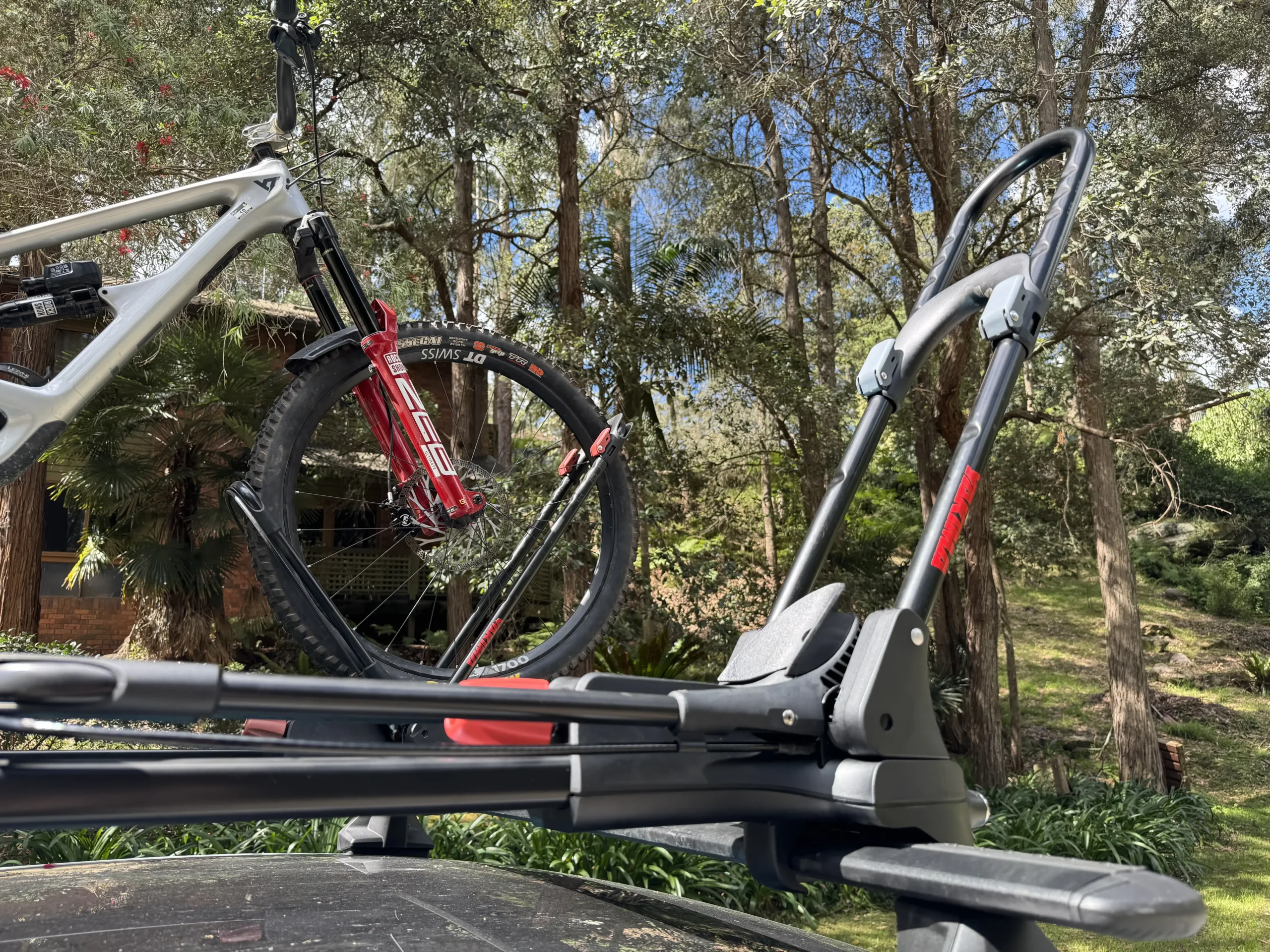
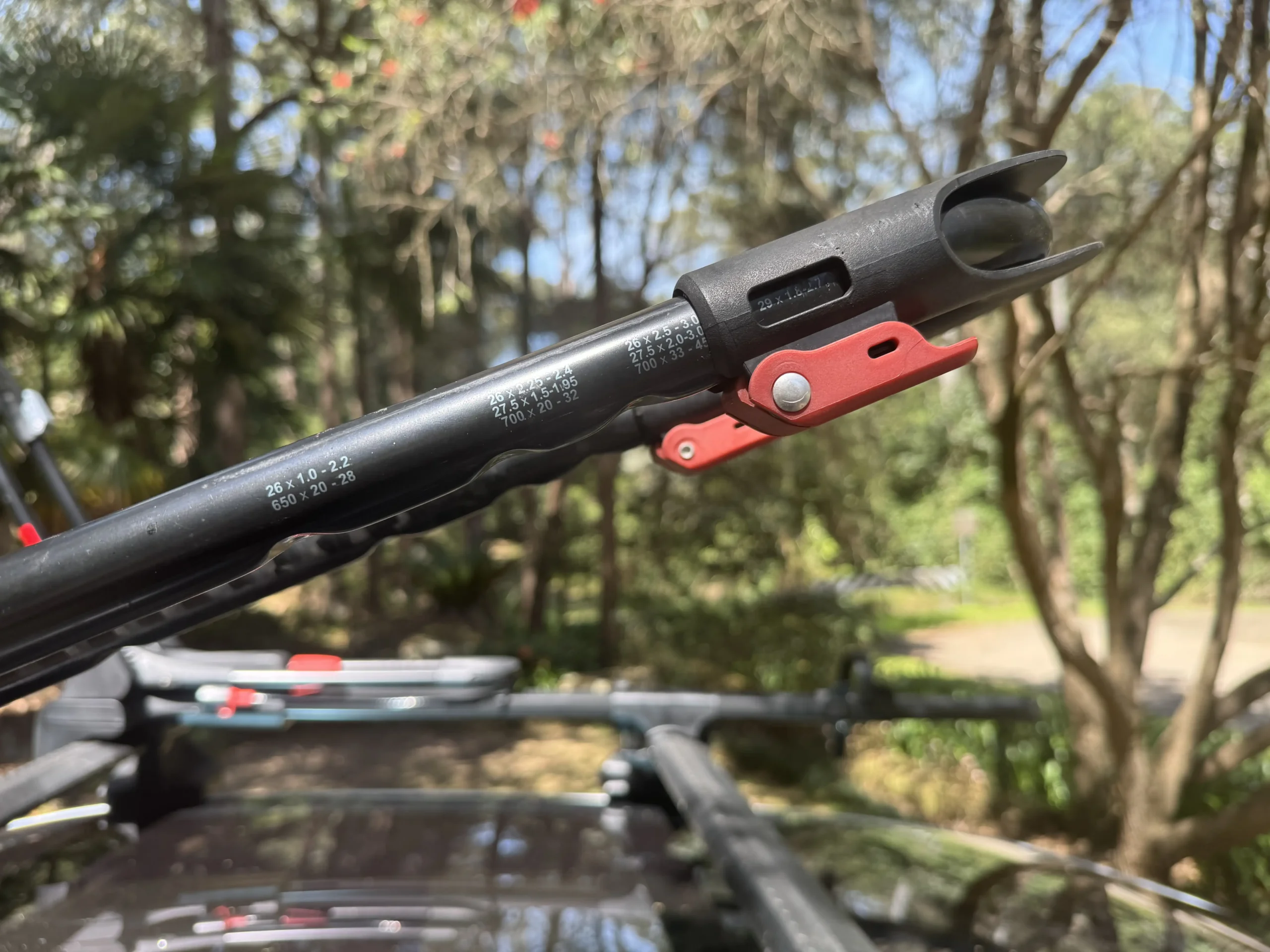
20 to 29 inches, carbon or alloy, any brakes or axles, one rack
This is the FrontLoader's real strength. Because it only holds the tyres, almost any bike fits, and switching between them takes seconds. Slide the front wheel mechanism to suit the wheel size, slide the rear tray across, and you're off. No tools, no adapters, and no thru-axle fork mounts to fiddle with. Here's what I've carried on mine:
The stock rear strap has handled every tyre I've tried, up to 2.6 inches. Some owners report the strap being too short on 2.4s, but I haven't had that problem.
The one catch with long bikes. My XL Capra does fit on the new rack with the original end cap in place, and it's fine to drive like that. But the rear wheel tray ends up pushed hard against the end cap's retaining knob. When I unload the bike and the rear wheel rolls back, it takes the tray with it and pops the end cap out. It happened the very first time I used the new rack.
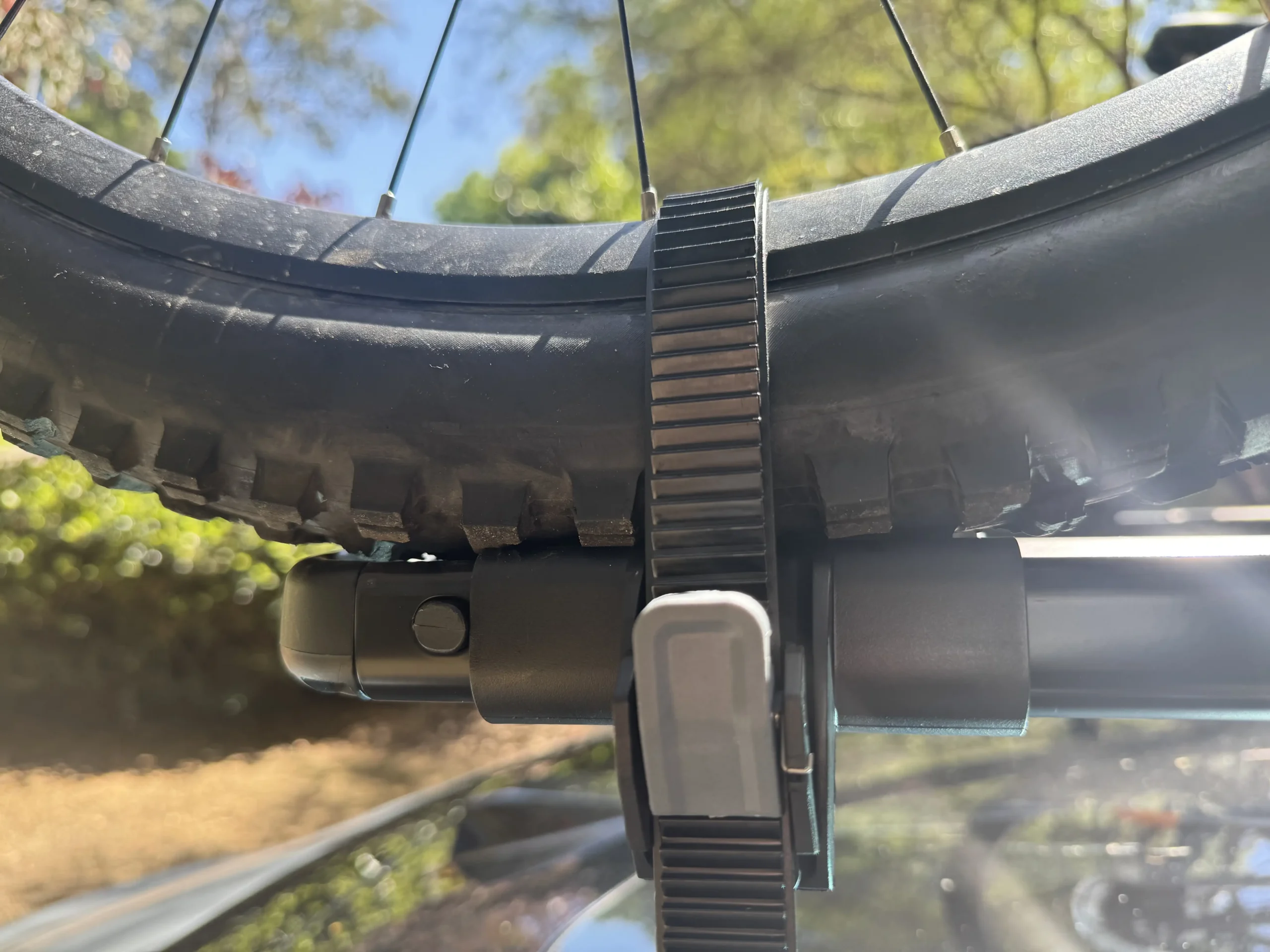
My XL YT Capra on the new FrontLoader, with the original end cap still in place
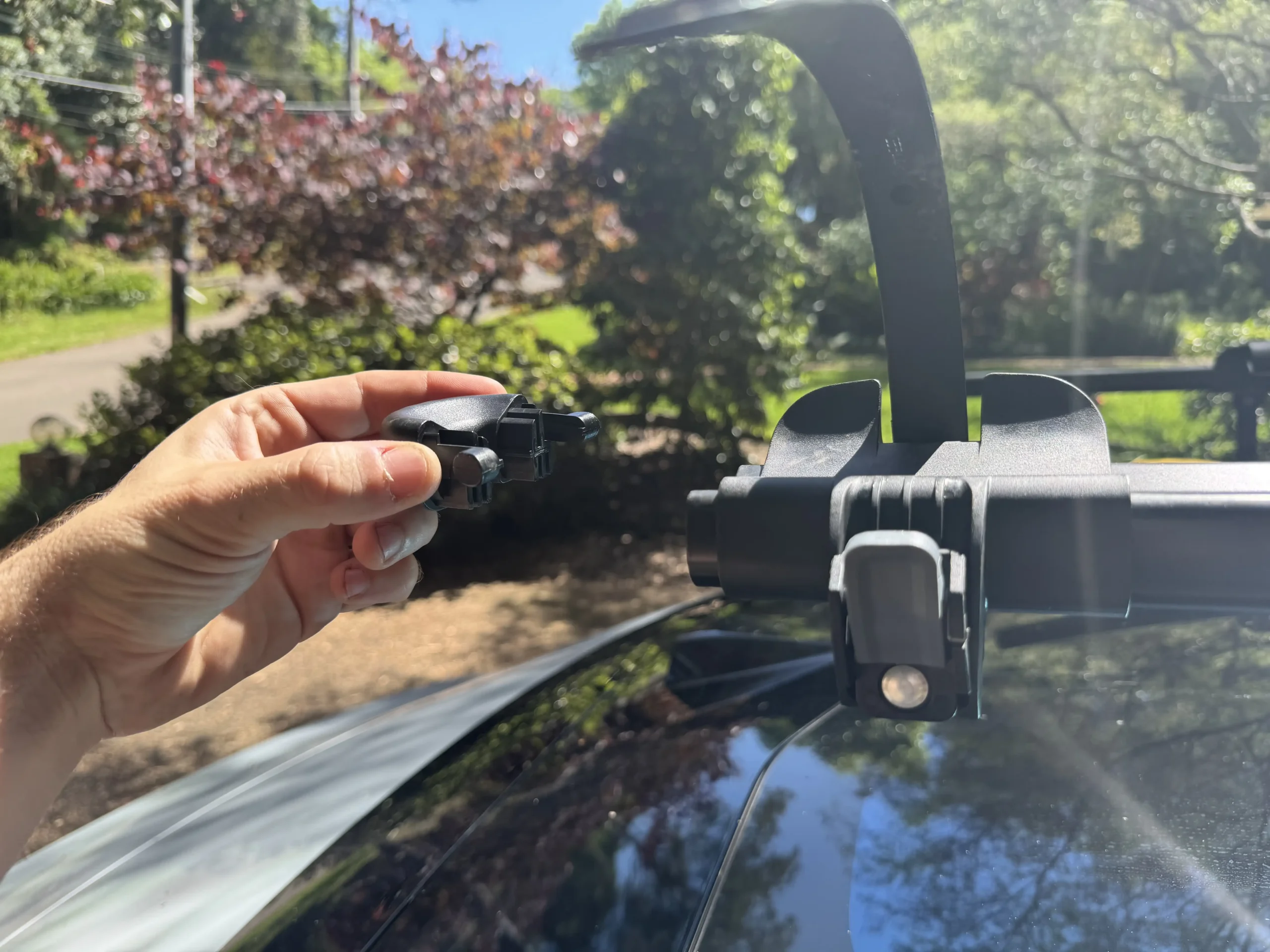
The end cap popped out after unloading the Capra, on the very first trip with the new rack
The same thing happened on my original rack, except I didn't notice. The end cap popped out as I unloaded, and I drove around without it. With no bike on the rack and nothing to stop it, the rear tray eventually slid off the back and I lost it on the road. A replacement tray cost about $30.
To be clear, a loaded bike is never at risk. With a bike strapped in, the rear tray can't move. The risk is damaging the end cap and losing the rear tray once the rack is empty.
On the old rack, rather than refitting a new end cap, I fitted a thick cable tie as an end stop. That gave me the extra couple of centimetres the long bikes need, and it's been working perfectly for three years. It's my workaround, not something Yakima approves, so check it regularly. Shorter bikes will never need it.
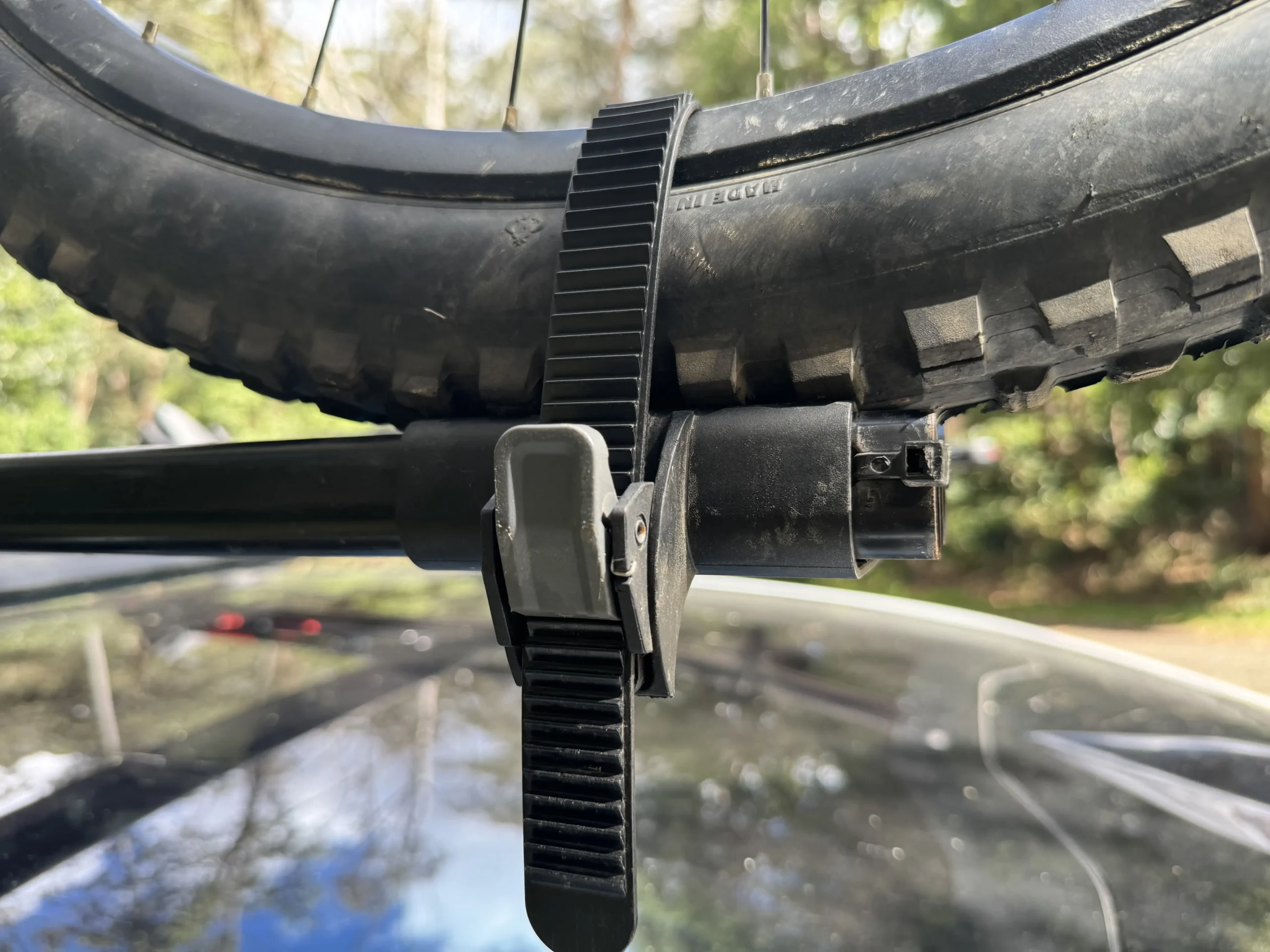
My XL Capra on the original rack, with the cable tie end stop in place of the end cap
Stability: 7/10
It wobbles enough to look worrying, but it has never let go
I won't pretend otherwise: bikes move around on the FrontLoader. The 24-inch kids' bike felt very solid on the new rack, but my XL Capra sways a fair bit. A lot of that movement is in the tyres, but some of it comes from everywhere, including the Thule bars themselves. No single part has excessive play.
The worst of it comes on trailhead access roads better suited to a 4x4 than a "Coupe" EV. There the bike rocks around violently enough that it makes me feel quite uneasy. But... it's happened countless times, and I've never had a bike shift on the rack, loosen, or look like popping off the bars.
Because the rack only holds the tyres, the tyres act as springs, and some movement is the trade-off for never clamping the frame or fork. Owners on forums say the same thing: one MTBR poster found most of the movement was in the tyres, not the rack. After five years mine shows no sign of fatigue, but it's still worth checking the dial and strap are tight before every drive.
The glass roof on my Polestar turned out to be an unexpected bonus. I can see the bike the whole drive, which means I can check the mounts at a glance (they've always looked solid), and I'm never going to forget it's up there before driving into a garage... I hope!
Durability: 9/10
Five years outside, and all it has to show is faded plastic
I haven't looked after my first FrontLoader well. It's spent long stretches left on the car, out in the weather. The black plastic has faded a little, and that's about it: no rust, no corrosion, no cracked parts, no slop in the hoop or the dial.
The only failure was the lost rear tray, which was down to the end cap issue above rather than wear. Keeping the rack in the garage between trips would keep it looking newer for longer, but I've been impressed by how well it's held up with very little care.
Noise: 8/10
No whistle, just the usual rush of wind
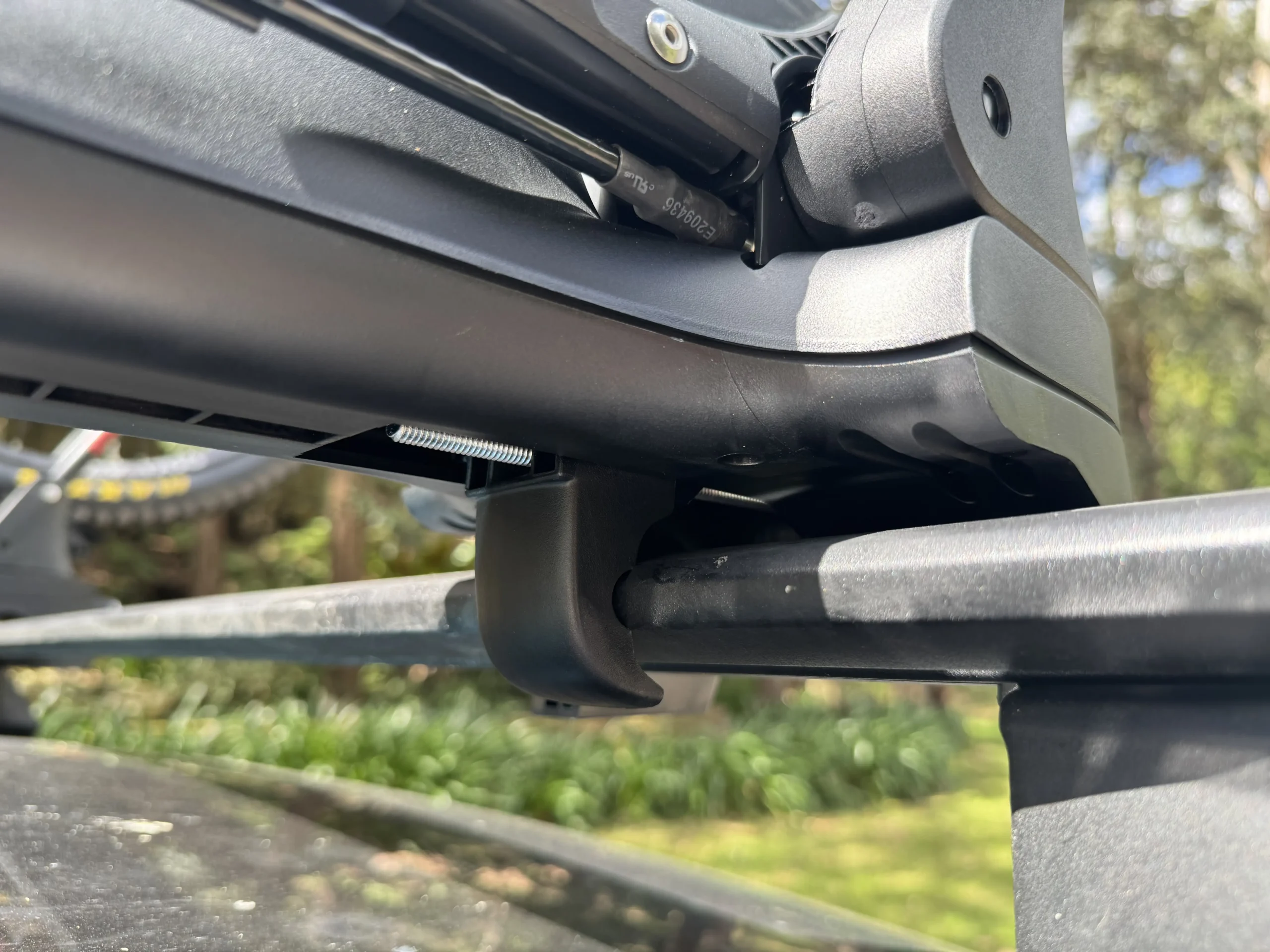
It adds wind noise, as any roof rack does, but there's no whistle. It's a normal rush of wind, and honestly the Thule bars seem to make more noise than the rack itself.
Security: 6/10
Fine for a quick stop, not for leaving overnight
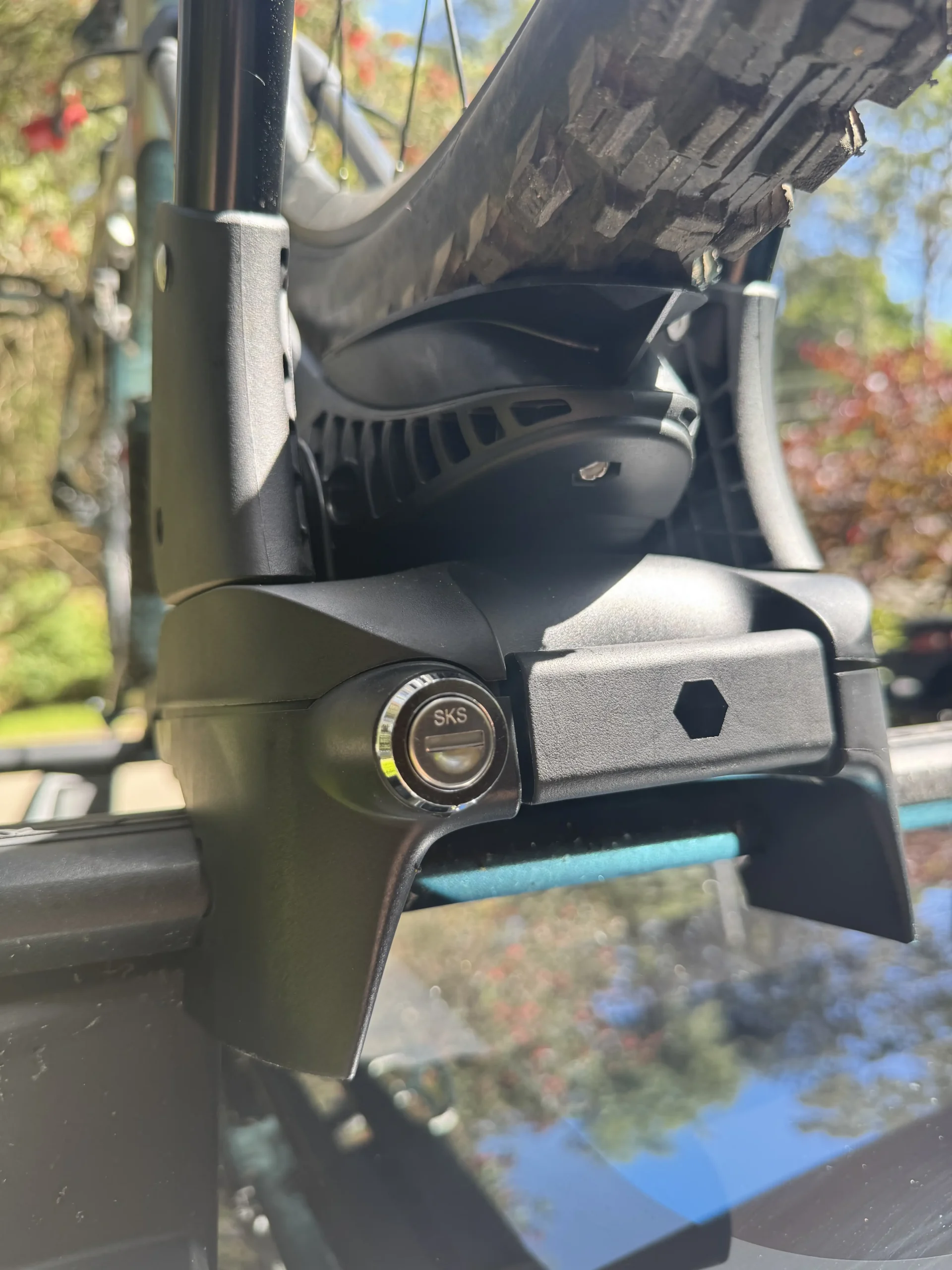
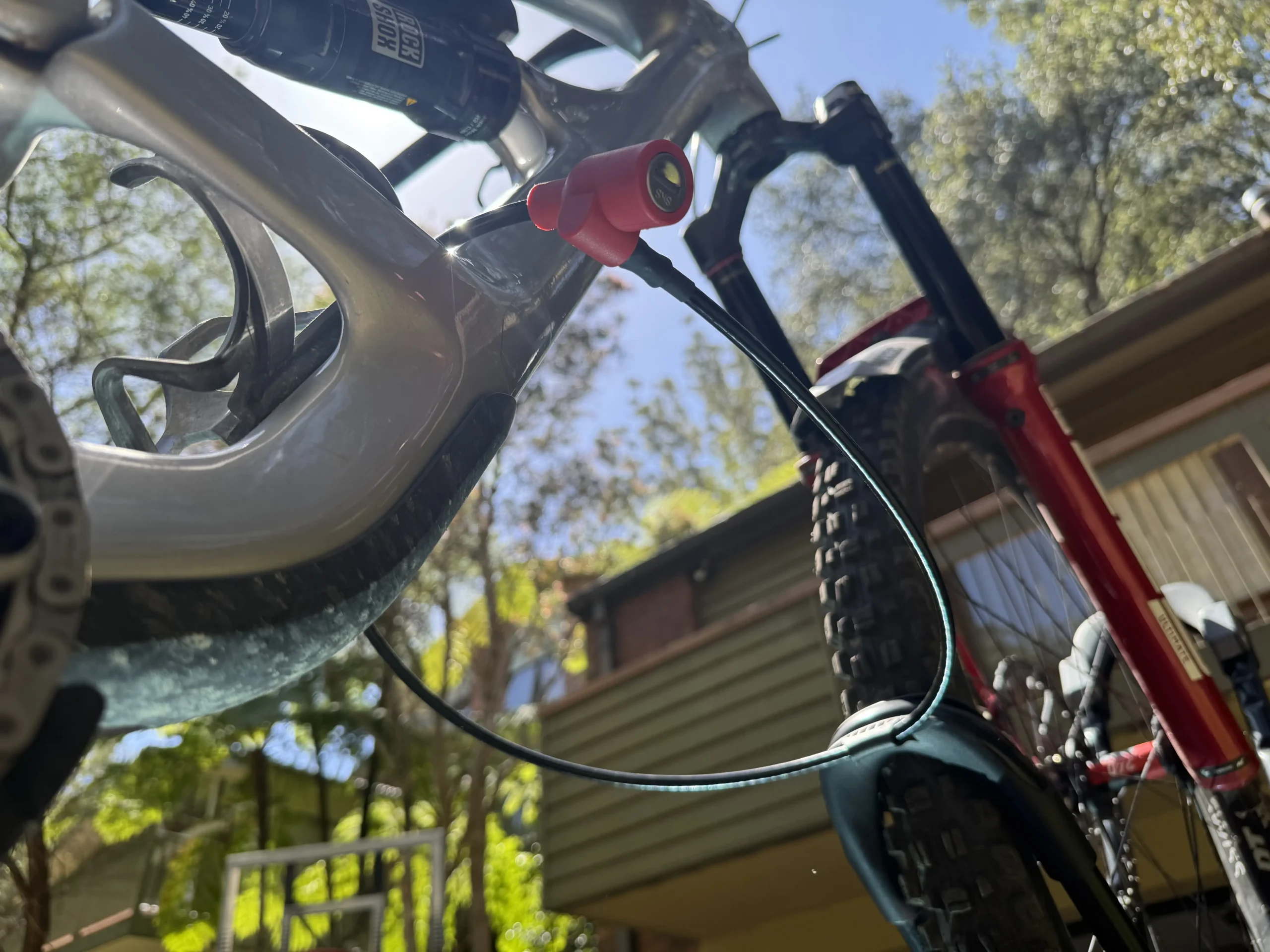
There are two key locks. The first locks the front mount so it can't be unwound, which means nobody can take the carrier off the roof bars. The second is on a shortish cable that loops through your frame and locks the bike to the carrier. Together they'll stop an opportunist and slow down anyone who has come prepared, while drawing a lot of attention. I'm happy to leave a bike up there in a supermarket car park while I grab a post-ride kombucha. I wouldn't leave it unattended for long periods of time.
Five years apart: what's changed?
As far as I can tell, very little. The lock cores are now included, and that's the only difference I can spot between my five-year-old rack and the new one. Considering how well the old one has held up, I'm fine with that.
Overall Rating: 8/10
The simplest way I've found to carry the whole family's bikes
Conclusion
After five years, a lot of rough access roads and very little care, my original FrontLoader still does exactly what it did on day one. It's quick to load, it carries everything from a 20-inch kids' bike to an XL enduro bike without touching the frame, and the only part I've had to replace cost about $30.
It isn't perfect. Bikes move around more than you'd like, though mine has never let go. Long 29ers push the rear tray against the end cap, which can pop out when you unload. And lifting a big bike onto a tall car is hard work, as it is with any roof rack.
For $230 I'm not complaining. I liked the first one enough to buy the same thing again, and that says more than any score.
Yakima FrontLoader FAQ
Does the Yakima FrontLoader fit kids' bikes?
Yes, and it's one of the best things about it. It takes 20-inch to 29-inch wheels, and I've used it with 20-inch and 24-inch kids' bikes without any problems. Adjusting it between a kid's bike and an adult bike takes a few seconds.
Is the FrontLoader safe for carbon frames?
Yes. It only holds the tyres, so nothing clamps the frame or fork. That's the main reason I bought one in the first place.
Does it work with thru-axles and disc brakes?
Yes. The front wheel stays on, so the axle standard doesn't matter, and nothing comes near the rotors.
What is the maximum wheelbase for the Yakima FrontLoader?
US listings give 48 inches (about 1,219 mm), though the Australian product page doesn't list it. My XL Capra fits, but only just.
Will a Large or XL 29er enduro bike fit?
Yes, but it's tight. My XL YT Capra fits on the new rack with the original end cap in place and is fine to drive with. The catch is that the rear tray presses against the end cap, and unloading the bike pops the end cap out. If you don't notice and then drive with the rack empty, the tray can slide off. On my old rack, a cable tie used as an end stop has solved it for three years, but it isn't a Yakima-approved fix.
Is it normal for the bike to wobble on the FrontLoader?
Some movement is normal because the rack only holds the tyres, and a lot of the movement comes from the tyres flexing. Bigger bikes move more. Mine has never come loose in five years, but always check the dial and rear strap are tight before you drive.
Does the FrontLoader come with locks?
Yes. The current Australian version (#8002104) includes two SKS key locks. One stops the front mount being unwound, so the carrier can't be taken off the roof bars, and the other is on a short cable that loops through your frame. My older rack didn't come with the lock cores, and they were an extra cost.
Yakima FrontLoader or HighRoad?
The HighRoad takes heavier bikes, longer wheelbases and wider tyres, but costs a lot more. For a family's mix of kids' and adult bikes, the FrontLoader is all you need.
Is my second-hand FrontLoader part of the recall?
Yakima recalled some FrontLoaders shipped between March and December 2010. Recalled units have four wheel positions on the front hoop, while later units have five. If you're buying an old one second-hand, it's worth checking.
Sources
Yakima AU FrontLoader product page
Yakima AU: FrontLoader vs HighRoad
US retailer FrontLoader spec listing
MTBR: Yakima wobble thread
Bicycle Retailer: 2011 FrontLoader recall
Written and photographed by Tom Ford for Boosted Media
Back to Boosted MTB